
Search in our Website for Amazing Tours Perfect Hotels Wow Destinations Program Details Best Deals |


Main Menu
Most Searched Items On This Website
- Andaman Tour
- Kashmir Tour
- Kerala Tour
- Himachal Tour
- Arunachal Tour
- Sikkim Tour
- Thailand Tour
- Uttarakhand
- Meghalaya
- Leh-Ladakh
- North India
- Srilanka Tour
- Group Tours
- Bali Tour
- Nepal Tour
- Dubai Tour
- Darjeeling Tour
- Bhutan Tour
Other Useful Links
- Offbeat Tours
- Feedback
- Gallery
- Brochure
- Carrier
- Partner
- Domestic
- International
- Adventure
- Snowscape
- Mountain
- Sea Beach
- Weekend Tours
- Forest Safari
- Day Outs
- Religious
- Luxury Tour
- Budget Tour

Spiti Valley – A Journey to the Roof of the World
- 15th November 2022
Chapter 1 – The First Whisper of Spiti
I heard of Spiti Valley in a dusty café in Manali, when a weathered biker leaned over his chai and said,
“If you want to know what the moon feels like, go to Spiti.”
The words stuck. I pictured a barren, rugged land where the air was thin and silence had weight. Months later, with a small backpack and a big appetite for adventure, I was on my way to this high-altitude desert — wedged between Tibet and India, known in Tibetan as Piti, “The Middle Land.”
Spiti is not just a valley. It’s a feeling — of standing at the edge of the world, where mountains meet the sky and human life adapts to extremes.
Chapter 2 – The Geography & Mystery of Spiti
Spiti lies in the Lahaul and Spiti district of Himachal Pradesh, tucked between Tibet to the east and Ladakh to the north. At altitudes averaging 3,800–4,500 meters, it’s a cold desert, carved by the Spiti River over millennia.
Its nickname — The Middle Land — comes from its position as a cultural bridge between India and Tibet. For centuries, traders, pilgrims, and monks traveled through Spiti, carrying salt, wool, and Buddhist teachings along ancient routes.
Chapter 3 – How to Reach Spiti
Getting to Spiti is an adventure in itself. There are two main routes:
1. Via Manali – Rohtang Pass – Kunzum Pass
Distance: ~200 km
Time: 9–12 hours
Highlights: Rohtang Pass, Chandra Valley, Kunzum La (4,590 m).
Best Season: Mid-June to October (closes in winter).
2. Via Shimla – Kinnaur – Reckong Peo
Distance: ~420 km
Time: 2–3 days with stops
Highlights: Sutlej River valley, Sangla, Kalpa.
Best Season: Year-round (but heavy snow may block roads in Jan–Feb).
Pro Tip: Many travelers do the full circuit — entering via Shimla and exiting via Manali — for variety.
Chapter 4 – The Journey Begins
I chose the Shimla–Kinnaur route to acclimatize slowly. The drive wound through pine forests, apple orchards, and turquoise rivers. At Kalpa, I spent a night watching the Kinner Kailash range glow pink in the evening sun.
Beyond Kalpa, the terrain began to change — green turned to brown, trees gave way to bare rock, and the air felt drier. The road clung to cliffs above the roaring Sutlej River, with “shooting stone” warning signs every few kilometers.
By the time I reached Nako Village at 3,625 meters, I was in another world — prayer flags fluttered over mud-brick homes, and the only sound was the wind.
Chapter 5 – First Glimpse of Spiti
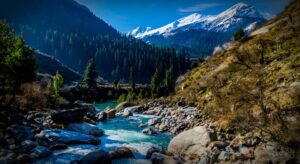
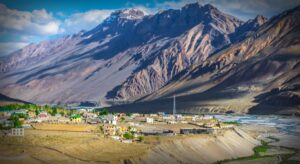
Crossing into Spiti district felt like stepping onto another planet. The valley opened up, framed by jagged, snow-dusted peaks. The Spiti River, a glacial blue ribbon, snaked through the barren land.
My first stop was Tabo, home to the Tabo Monastery, over 1,000 years old. Inside its mud walls, ancient frescoes told Buddhist stories in earthy colors, and butter lamps flickered in the dim light. The air smelled faintly of incense and history.
Chapter 6 – Villages of the Middle Land
Spiti’s charm lies in its villages — each with its own rhythm and story.
1. Tabo
Known as the “Ajanta of the Himalayas” for its ancient cave paintings.
Monastery founded in 996 AD.
Surrounded by caves where monks meditate.
2. Dhankar
Perched on a cliff at the confluence of the Spiti and Pin Rivers.
The old monastery seems to defy gravity.
A trek leads to Dhankar Lake, a turquoise gem at 4,140 meters.
3. Kaza
The administrative center of Spiti.
A mix of traditional homes, cafés, and shops.
Base for exploring nearby villages and monasteries.
4. Kibber
At 4,205 meters, once considered the world’s highest village with a motorable road.
Gateway for snow leopard spotting in winter.
5. Langza
Famous for fossils — you can literally find 100-million-year-old ammonites in the soil.
Dominated by a huge Buddha statue gazing over the valley.
6. Hikkim
Home to the world’s highest post office at 4,400 meters.
Sending a postcard from here is a must.
7. Komic
At 4,587 meters, one of the highest inhabited villages in the world.
The Tangyud Monastery here looks straight out of a Tibetan painting.
Chapter 7 – Monasteries & Spirituality
Spiti’s monasteries are living museums of Tibetan Buddhism.
Key Monastery: The largest and most iconic, with tiered architecture clinging to a hill. Its library houses rare thangkas and scriptures.
Tangyud Monastery (Komic): Fortified, with red walls against barren mountains.
Kungri Monastery: The spiritual heart of Pin Valley, known for the Cham dance festival.
I spent a morning at Key Monastery, sipping butter tea with monks as they recited prayers. Outside, the wind carried the sound of the river below.
Chapter 8 – Adventures in Spiti
Spiti isn’t just for contemplation — it’s also for adrenaline.
Trekking: Pin Parvati Pass, Spiti Left Bank Trek, Dhankar Lake trek.
Biking: The Manali–Spiti route is legendary among motorcyclists.
Camping: Near Chandratal Lake under a sky bursting with stars.
Wildlife: Snow leopards, Himalayan ibex, and blue sheep.
Chapter 9 – Chandratal: The Moon Lake
Chandratal, at 4,300 meters, is a high-altitude lake shaped like a crescent moon. The water shifts from blue to green to mirror-silver depending on the light. Camping here is an otherworldly experience — the night sky feels close enough to touch.
Legend says Chandratal is where the gods descend to earth. Sitting by its shore at sunrise, I almost believed it.
Chapter 10 – Life in a Harsh Land
Winters in Spiti last 6–7 months, with temperatures dropping to -30°C. Villages get cut off, and life slows to survival mode. Homes are made of mud and stone, with small windows to keep in heat.
People here grow barley and green peas in the short summer, herd yaks, and trade goods with nearby valleys. Hospitality is sacred — a guest is offered tea and food before anything else.
Chapter 11 – Food of Spiti
Thukpa: Noodle soup with vegetables or meat.
Momos: Steamed dumplings.
Tsampa: Roasted barley flour mixed with tea.
Butter Tea: Salty, with yak butter.
Chhang: Local barley beer.
One evening in Kibber, my host served me hot thukpa while the wind howled outside. That bowl of soup felt like a shield against the cold.
Chapter 12 – Festivals & Culture
Losar: Tibetan New Year, celebrated with dances and feasts.
Gustor Festival (Komic & Key): Mask dances depicting the triumph of good over evil.
Chaam Dance: Performed at Kungri Monastery, full of vibrant masks and costumes.
Chapter 13 – Best Time to Visit
Summer (May–October): Roads open, trekking possible.
Winter (Nov–April): For snow lovers and wildlife spotting, but harsh conditions.
Chapter 14 – Travel Tips
Permits: Foreigners need an Inner Line Permit (available in Kaza).
Acclimatization: Gain altitude slowly to avoid AMS.
Cash: ATMs are scarce; carry cash.
Connectivity: Patchy network; BSNL works best.
Respect: Monasteries have rules — ask before taking photos.
Chapter 15 – Sample 10-Day Spiti Itinerary
Day 1: Shimla → Sarahan
Day 2: Sarahan → Kalpa
Day 3: Kalpa → Nako → Tabo
Day 4: Tabo → Dhankar → Kaza
Day 5: Explore Langza, Hikkim, Komic
Day 6: Key Monastery → Kibber
Day 7: Pin Valley → Kungri Monastery
Day 8: Kaza → Chandratal (via Kunzum Pass)
Day 9: Chandratal → Manali
Day 10: Departure
Chapter 16 – Why Spiti Changes You
Spiti humbles you. The scale of its mountains, the simplicity of its villages, the kindness of its people — they remind you how small and temporary we are, and how beautiful that can be.
Here, the sky feels bigger, the nights quieter, and the days longer — as if time itself slows to let you breathe.

Contact Us
Don't feel hesitate to contact us, We are always available to assist you for any assistance or suggestions
Email
info@funztour.in funztour.india@gmail.com
Website
www.funztour.in
Phone
+91 93300 98589 ; +91 89028 74251